I finished Watership Down a few days ago. It's Richard Adams's 1972 adventure novel about a group of bold rabbits who flee their endangered warren, trek several arduous miles across the British countryside, and set up a new, utopian home on a hill free from danger.
Along the way, they meet several different groups of rabbits living under diverse circumstances, and the book got me thinking about the relationship between authority and society.
When the book opens at the Saddleford Warren, we witness a fairly typical governing structure. There's no immediate, undeniable threat to the rabbits of Saddleford--aside from routine harassment by foxes and stoats, the occasional bout of white blindness and other illnesses, and a bad winter or two. The rabbits think of themselves as the race with a Thousand Enemies--dogs, cats, men, owls, etc.--so they are fully accustomed to these obstacles. The threarah--or king, of sorts--is nice but aloof, comfortable and distant in his position of power, safely assuming that everything will continue as always. His Owsla--or military, kind of--is prone to power-tripping, over confidence, and machismo, but they're not particularly corrupt. The every day rabbits, those who don't hold positions of authority, occasionally feel the dominating shadow of those above them in the hierarchy, but for the most part their lives are quotidian and uneventful.
Like the frog in the pot of water steadily increasing to a boil, the Saddleford rabbits are so accustomed to everything working out decently that new and unusual signs of danger are imperceptible to them. When Fiver, a small and generally ignored young rabbit with the rare rabbit gift of psychic insight, receives a premonition that nearby humans are bringing unbridled terror to their homeland, the majority of his rabbit compatriots are too comfortable to heed his warning. Only those with nothing to lose and those who trust in possibilities beyond what they can plainly see in front of them follow Fiver in his quest for safer territory, the threarah and many others staying behind with no worries.
What happens to Saddleford is nothing short of a rabbit holocaust, perpetrated by human building developers.
It's easy to relate to Saddleford's courtship with imminent demise. There are those who proudly buy gas guzzlers without caring to think what might happen when all the gas runs out. There are those who rifle through hundreds of pounds of disposable plastic a year or who willingly buy into the vast, mechanical meat industry without regard to biological mutations, chemical washes, exorbitant amounts of methane/greenhouse gas, e coli and mad cow outbreaks, and the American obesity epidemic which threaten all of our livelihoods. We happily light the next cigarette because none of the others have killed us yet. Or we allow corrupt powers to escalate to the point of blacklistings, witch hunts, or fascist rule.
But a dozen or so male rabbits, led by Fiver and his trusting, headstrong friend Hazel, escape in time, journeying across rivers and rough terrain, putting unused skills to the test, discovering about themselves and each other and how to survive, and learning to trust and appreciate what everyone has to offer.
Eventually they encounter the rabbits of Cowslip, a utopia named after a prized and tasty marigold flower. The rabbits there--who live in a huge, well-worn, extremely comfortable warren on fruitful land completely devoid of predators and ill weather conditions--are large, healthy, and well-fed with shiny coats and a strange, regal smell. They are also a bit strange, engaging in strange social habits and modern forms of art and poetry quite unlike their own traditional, heroic storytelling. Though the Saddleford refugees believe in the divine craftiness of the legendary El-ahrairah, cunning father to all rabbits, the Cowslip rabbits have learned not to believe in such things; they are hopeless, dreamless atheists, cynical and obedient, and their communication with each other is elusive and lacking in intimacy.
Of course, utopia steams from words meaning "nowhere," and Cowslip is hardly as great as it first appears. The Cowslip warren is on the outskirts of a farm, and the farmer feeds them well, protects them from predators, and allows them to live full, happy lives until--every so often, and not so often as to cause alarm--he kills one of them for supper.
And so the Cowslip rabbits, who have forgotten how to use their unnecessary natural skills--how to find food, how to outsmart a cat--have attempted to escape through suicidal poetry, teaching themselves not to expect too much from life and not to develop too close a bond to anything or anyone on earth. They live their spoonfed lives forever unchallenged and often unthinking, and then they die, and such is life.
How closely does the resemble a life of shutting off alarm clocks, going to the office, walking down the grocery aisles, using the credit card, eating fast food, watching the television, drinking a beer, and falling asleep? All while a million advertisements for a thousand time-saving, new, and spectacular devices compete for our attention. The Internet, streaming three-way video chat, and one thousand text messages a month in our pocket. Slaughtered chicken on a bun with lettuce, pickles, and tomatoes tasting and looking the exact same three hundred and sixty-five days a year, assembled by half a dozen minimum wage workers, for only ninety-nine cents. Liposuction without having to move a muscle, earlobe remodeling to fix those saggy ears, and a tiny, white pill to keep you from thinking about killing yourself--may cause amnesiac sleep-driving, excessive gambling, and suicide.
They escape from Cowslip and settle into what will become their own warren in the perfectly suitable terrain of Watership Down, but only then do they realize that they're a society of men with no hope of prolonged survival through the generations.
Their quest for does brings them to two other groups of rabbits.
On a nearby farm they encounter a hutch with four naive pet rabbits, much like the Cowslip rabbits in size and health but with no deceptive pretense of freedom. The hutch rabbits know they're not wild. They know they are the playthings of a nice, little human girl. They have nothing to fear, nothing to worry about, no need for government, and very little to think about. They're neither happy nor sad, and they're quite stupid. Adams doesn't dwell too much on them.
And miles away is the nearest warren, Efrafa, a concealed, underground military dictatorship. The threarah, General Woundwort, once suffered at the hands of human interference, and since then he has lived his life in fear of the evils of men. With a thirst for power and an allegiance to the necessity of discipline in order to safeguard freedom and the future, Woundwort organizes a tightly run totalitarian state. Rabbits are evenly assigned to different groups at birth, and they remain in these groups for life. The smallness of the groups allows for closer, more orderly control. Rabbits cannot leave the warren except with their small groups at appointed times, and always under close inspection. Allowing no rabbits to wander freely and openly ensures that no humans or predators will ever be alerted to the presence of the warren, insuring the ongoing existence of the warren. For this reason, no rabbits can ever emigrate from the warren, drawing attention to it in the process. All wandering rabbits caught within range of the warren are taken prisoner and forced into the vast, underground, prison-like network, never to wander free again. Disruption from the status quo is met with harsh punishment, the only hope of reward is from being considered worthy enough to join the corrupt owsla and reap its meager rewards, and the only means of escaping is by dying while on a patrol.
Efrafa is a society where freedom has been exchanged for security, where fear of supremely evil and powerful enemies dictates all of culture, where a power hungry, slightly insane, and wholly misguided leader gradually takes more and more liberties within his position of power, and where the majority of rabbits generally succumb to the idea that they are powerless to change their desperate lots in life. Sounds a lot like the Bush Administration.
Watership Down is a great, fun read, always engaging, sometimes humorous, and at times emotionally resonant. I enjoyed it far more than The Hobbit and The Lord of the Rings. Like Tolkien, Adams dabbles in "allolinguistics"--the creation of fictional languages. He has introduced Lapine, the rabbit tongue, and Hedgerow, the lingua franca of woodland creatures, to the world of languages. It makes me more certain that allolinguistics is something I want to play with in my own fiction one day.
Adams also got me thinking about the possibility of using non-human characters in novels. He also wrote The Plague Dogs, which I'm interested in reading.
What's compelling about the rabbits and their mythology is that, like humans, they think that they are the most important and divine species on earth. Humans point to the use of tools and language, the knowledge of their death, the existence of the soul, the (questionable) ability to reason, and other such attributes as proof of their predominance; rabbits point to their ability to speedily reproduce, to fill the earth quickly and joyfully, to their speed, their cleverness, and their martyr complex.
So what about cockroaches? Unchanged for hundreds of millions of years, outliving the dinosaurs, resistant to radiation, capable of surviving half an hour underwater, forty-five minutes without air, a month without food. They reproduce like crazy. They live clandestinely everywhere, much to the folly of the so-called human rulers of the earth. And sometimes it's nearly impossible to kill them.
How about a book where cockroaches are god's master race?
Showing posts with label fiction. Show all posts
Showing posts with label fiction. Show all posts
03 August, 2009

25 March, 2009
WORKING IT OUT
On Tuesdays Allen ditched work promptly at five and took Route 11 to the Smash Emporium. The emporium was invite-only, and Tuesday evenings were when Reub scheduled his appointments. It was the perfect workout to get him through the rest of the week, neither too early nor too late.
A few sudden turns put the North Vegas suburbs behind a hill, and the next half hour was rocky terrain, sun-hardened brush, and telephone poles. The setting sun angled through his window, and the hot sun provided the warm-up to his exercise. He’d remove his tie and shirt behind the wheel, putting on a more comfortable tee. He kept a pair of dusty boots beneath the back seat. By the time he reached the manufactured community where the emporium was, a modern marvel of a town with bright green golf courses, quartz blue swimming pool oases, and gleaming white second homes, he was mentally and physically prepared to break as many things as possible.
The Smash Emporium was the foreclosed home of a recessed banker. His partners had gotten a bailout while he had been kicked out, and twenty-four hours later he had blown out his brains. That was in Chicago. He had apparently tried gulping a pint of Drano mixed with brandy mixed with ice, but he had vomited that mixed with blood all over his bathroom. The shock of that hadn’t been enough to change his mind about death. He just used a gun instead. Maybe he didn’t want to clean up the mess. Allen knew this because Reub did, and how Reub knew Allen didn’t know. Reub had snatched up his Nevada vacation estate cheap—the real estate market for an impossible luxury neighborhood in the middle of the desert was plummeting.
The estate was three floors with an attic, a basement, a kidney-shaped pool, a detached two-story garage, a now-dead garden, and a private shooting range. Reub had filled it with other items he got cheap from online auction sites, estate sales, thrift stores, big box discount retailers, and junkyards. He stocked each room according to a theme. An office with a wooden desk, a personal computer, a complicated telephone and fax machine set up. A living room with a flat screen television wired to other expensive electronics. Kitchen cabinets full of dishes, juice glasses, jars of tomato sauce, and gallons of milk. A home library with tall shelves overflowing with books. A car in the garage. Most of it was junk that didn’t work, but none of it looked like junk—the illusion of perfect working condition and affluence was always maintained. And for a high but fixed price, the customer could parade through the house with provided sledge hammers, flasks of lighter fluid, chipped hatchets, and hard fists and break as much as he or she wished in whatever ways thinkable. Unreasonable damage to the house itself was added to the bill, of course. And every week by appointment time the house was restocked to pristine, livable condition with new furniture, unique antiques, and whatever special touches Reub had managed to dig up. He was an artist of interior decoration, a master at recreating polished, functional environments that cried to be destroyed.
“I got something you’ll like,” Reub said, taking Allen into the lobby. “I remember you told me to keep an eye out for something matrimonial. Well, I’ve been putting something together for a couple of months now, ever since then, and well—it’s in the parlor. You can do it first. Or you can work your way up to it. Whatever you want.” He was excited, eager to unveil his newest creation. He always got giddy when he talked about his best new offerings. He prided himself on providing rare, wonderful, and suitable items to annihilate.
But Allen couldn’t jump right into the best part. He needed more mundane situations to blister first. He needed to save the catharsis for last. Reub knew what Allen did for a living, knew that he owned a company that sold audio and video devices to casinos under contract, decking out blackjack tables with tiny flatscreens that blared advertisements and distracted less seasoned players from keeping their attentions on the game. Giant monitors that wailed previews of burlesque shows and musical theater. Reub knew what Allen’s office was like, knew what irritations and stressful environments surrounded him on an average day. Reub knew about all his customer’s destructive fantasies. He sometimes knew what they needed to crush before they knew it themselves.
Allen loved kicking the computer monitor off of the desk, smashing it with his boot. He enjoyed the shattered glass, the finality of the sound it made. The way the shards splayed across the floor. You couldn’t put shattered glass back together. Every week, he also made sure he snapped the keyboard in half, sometimes pulling up on each end with his boot firmly planted in the center, sometimes repeatedly whacking it against the chipped and knicked desk.
He broke the dinner plates one at a time, trying to make music by spacing out the drops. It sounded like playing a cymbal. He took his time beating the refrigerator with a sledge hammer, until the muscles in his arms ached and sweat poured down his back.
Now he was ready for the power zone.
With his heart rate elevated and a healthy flush to his cheeks, he made his way to the parlor, where a wedding banquet awaited him. There was a buffet of gourmet food—glazed chicken and whole fish and steaming vegetables and seasoned rice—aside a stack of plates, with crystal champagne flutes waiting to be filled by heavy, corked bottles over ice. A three-tiered white cake trimmed with red candy roses stood on its own small table, a carving knife laid out beside it. A glittery, white “CONGRATULATIONS!” banner hung on the wall. Beneath a trellis wreathed with lilies stood two mannequins side by side, one in an elaborate white dress and veil, the other in a smashing tux. On a podium before them sat a thick, leather-bound Bible. Bouquets of lilies lined every wall, and folding chairs had been arrayed for an audience to view the blissful mannequin betrothed.
Allen’s first instinct was to strangle the bride, rip apart the dress, and smash the plastic limbs. Maybe give it a few stabs with the carving knife. But he held back. Better yet to first try on the tuxedo. To have a throw at the food and the wine glasses. To give the metal chairs a good beating. In due time the bride could get what she was due.
* * *
When he was out of breath and his muscles burned from the exertion, with endorphins and adrenaline coursing through his blood, he wrote out the check for Reub and waited for him to shut down and lock up the house. The smoke damage from the fire in the parlor would possibly cost him in the future, but it was nothing to worry about. Reub was happy it had been a success.
Reub each night always drove behind his clients back to North Vegas, where he would treat them to some drinks at one of the finer, low-key bars before retiring to his own home. Tourist rarely wandered up to North Vegas, so the bars were relatively unpolluted. The one he liked most had dim chandeliers veiled in maroon shades, glinting liquor bottles climbing to the ceiling, wall-sized mirrors in every direction, plush leather booths into which the clientele sank softly, and lazy jazz whispering from invisible speakers. The waiters wore white suits and all had slicked-back, black hair.
Reub insisted on being friends with all of his customers, on having social time after each session. He wouldn’t treat just any paying strangers to hours of violence; he needed to know that something average and normal occupied a part of all of them. The servers at the bar knew him well and treated him with warmth and respect.
“The thing about engagement is,” Allen explained while sipping at Drambuie, “it gives a woman permission to give up. Before that there’s a certain uncertainty. She doesn’t know if you really like her. And so she’s always trying to impress, at least as much as is reasonably possible. Otherwise, you could just as easily find someone else, some woman who’s got her shit together better. And like that you’re out, no explanation necessary. With engagement, though, comes responsibility. Responsibility on your part. You can’t just say bye-bye anymore. It’s more long-term, and so there’s more of a cushion for her.
“From the time I proposed to Allie to the time of our wedding day seven months later, she had put on so much weight that the ring I had bought her couldn’t even fit on her finger anymore. And let me tell you, she was hot. A redhead. I know, most of them are atrocious, but when you find one that’s attractive, it’s such a rare beauty. Ivory white skin, she had, but not, like, translucent. Not blue or veiny or freckly. Just spotless. And dark auburn hair.
“But then I proposed and she fucking ballooned. Inflated. Like a goddamn beached whale, she looked. Moby Dick, the white whale. That’s what she looked like. And ha ha, how cute, how funny, the ring doesn’t fit, how embarrassing, we’ll just get it refitted soon, ha ha. Right. No ring, no commitment. Soon as it was said and done I hightailed to the farm up in Burkett, fucked as many whores as I could in a seventy-two hour stretch, drove all the way back completely hammered—I don’t even remember the drive, to be honest—and as soon as I was back, I got that shit, that joke, annulled.
“And it’s about self-respect. And it’s about responsibility. And it’s about staying true to your word. There’s a promise in a proposal. It’s not a permission slip to do whatever the hell you please. Allie Franklin. She was a mess, Reub. A goddamn mess.”
He finished his drink and suckled on the ice cubes. He was relaxed. The workout had released a lot of tension, and it felt great to be unwinding with Reub. Reub understood, and he never judged. He saw the banality and frustration of society, knew where the fault lines were, how to erode it and shatter it. He knew what people needed and was honored to provide it. He was of an old style of entrepreneurs, a philanthropist as well as a capitalist, a fulfiller of needs, a provider of goods, a genius of innovation, not unlike Rockefeller or Ford. Humble and proud all at once, a man of strong character.
“I want to thank you again, Reub,” he said. “What you set up was swell. If there were more people like you running things, the world wouldn’t be headed down the hole.”
And they ordered another round of scotches.
* * *
Wednesday morning brought disappointment and vexation. Vandals had broken in, but the security cameras for some reason hadn’t been running, suggesting it could have been an inside job. There had been a lot of layoffs in recent months. Employees had been let go who had been there since the beginning—too expensive to maintain their high salaries in such a weak economy—and so there was much motivation for disgruntled behavior floating around.
Papers lay scattered everywhere, some of them ripped, many of them trampled on. The phones were missing, and the fluorescent light bulbs had been smashed. Most of the computers were busted out. Many of the cords were ripped and frayed.
It was early, and he wasn’t quite awake yet. Confusion and annoyance came naturally, but Allen had to work on building up his anger. They’d sue the security company, of course. What were they paying them for anyway? Everything was insured, so the financial loss wouldn’t be too great, but it would take time to deal with the police, to file the insurance claim, to sort out the mess, to buy new equipment. It was difficult to tell what documents had been stolen, what confidential information had been exposed. Such a waste of valuable time to rebuild and replace, to get everything back to smooth operation, as it was and how it should be. Such an obnoxious bother the disrespectful little shits had caused, to be so irresponsible and selfish, to damage other people’s hard work, to chip away at the foundations of society. He would find the worthless sons of bitches who had done this, and he would wring their goddamn necks.
By lunchtime, when he’d had his coffee and taken some time to think about the mess, he was suitably furious.
14 September, 2008
AMARANTH, CA
They waited in the car, the windows rolled down, peering up at the dusty signs and dark windows of the admissions booth. The cost was one dollar for adults, fifty cents for kids under 15, and free for those under five, but the sign was smudged with layers of dirt and no ticket collector was coming from the battered, wooden door. The door was heavy and fixed, had probably been stationary for decades, and a hole in the bottom corner of the window splintered outward in spider cracks.
“Get out and knock,” she said.
“There’s no one in there.”
He tapped on the horn.
The ghost town attraction was open from dawn to dusk and the dry sun was beating down one hundred and five degrees, but there was no one to be seen. There had been no cars, no buildings, no life or sign of life since they’d seen the billboard ten miles back on the highway. As touristy as it seemed, they didn’t expect it to actually be empty, to actually be populated solely by ghosts. They’d expected hokey reenactments and exaggerated museum attractions, slackjawed guides and fat wayfarers with overzealous camera triggers.
He shifted gears and proceeded down the dirt road, the baked gravel crunching beneath the tires.
“No,” she said. “Wait. We can’t.”
“Why not?”
“We didn’t pay. We’re trespassing.”
“There’s no one here,” he said. He kept driving. “Nobody at all.”
The road inclined and snaked to a three-pronged fork, where a signpost pointed one finger toward Town Hall, another to the mines, and a third to the cemetery. He turned left, a narrow path flanked by hills of sediment. Drought-blighted sagebrush sprouted thorny fingers to the white sky, their tiny yellow leaves not quite dead, begging the question of what worth was in living. The path rose and turned, and they passed through a massive wrought-iron gate, an inauthentic recreation, the town’s name sculpted atop in gothic curls. The town lay before them like an abandoned movie set, sandblasted by windblown debris. Everything was a shade of brown. The original buildings, over one hundred years old, were distinct in their stoic postures, stolid with dementia. The recreations, so obviously refabricated from newer materials and cheaper designs, were the decaying structures, weeded and gaping. A patina of tourism gilded everything with exuberant, sunbleached signs and Wild West themed kiddie rides from the world of imagination.
He pulled up to the general store and parked, climbed out and stretched his legs. She followed, leaving her door and her options open.
“You don’t think it’s unsafe?” he asked. “Maybe they had to shut it down?”
She scoped everything, walked to the store and approached the window. The glass was warped like melting, slightly less than transparent. She touched the cool panes and sniffed the black spots on her fingertips, then cupped her hands and peered through. Stillness resonated inside. Empty chairs and unmanned counters, mostly bare shelves with vintage cans and tins or with nothing at all on display. A life-size painting of a lady and a gentleman, their faces two cut-out ovals, stood against one wall. In a back corner was a Coke machine, at most only ten years, and she could imagine she heard it whirring still. She shivered.
A handwritten paper sign on the door read, “Sorry, we’re Open,” but it was locked. She turned around and folded her arms tight to her chest.
He was trying to maneuver a rusted wheelbarrow across the road.
She returned to the car and closed the door. A few seconds later, he joined her. The beeping of the seatbelt reminder, the hum of the engine, and the blast of the air conditioner were startling. She turned off the vents.
They drove back to the fork. “The mines?” he asked.
“No,” she said.
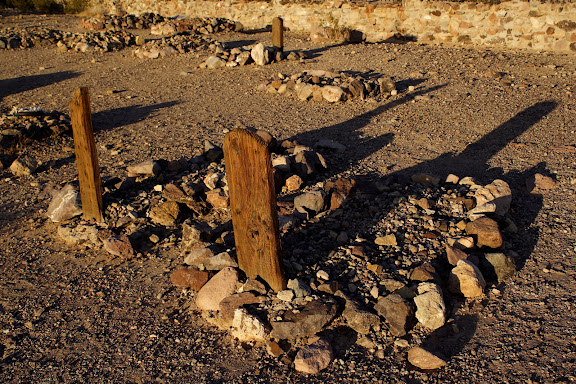
He drove to the cemetery, a small, pebble-strewn mound of a lot overlooked by the red mountains. They parked and walked through the murmuring gate. Human-length rock
He was higher, toward the back of the lot, and she walked to him. He stared down at six graves, six six-foot-long piles of stones with actual granite tombstones instead of wooden planks, their polished, flat faces engraved with real names and official dates. The deaths were scattered across the past fifteen years. Mary “Mary Lou” Ellerbee, “Postmaster General.” Joseph “Ole Buck” Hanson, “Six Shootin’ Sheriff.” Ronald Tyler, “Town Crier.” The most recent grave was less than two years old, and on it was engraved a sketching of the cemetery they were standing in, the mountains in the background, a cross atop one, and the sun setting behind, spewing forth crepuscular rays.
“They’re dead,” he said. “These are the people who ran the tourist stop. The ghost town died. It died back in the day and they rebuilt it, turned it into an amusement park. And then all those people died. There’s two eras of ghosts here.”
The new placards were the cleanest and brightest artifacts in the whole town, the most untinged by dust and commercialism, the most chilling and intimate.
“Should we say a prayer?” she asked.
He smiled.
Ronald Tyler, “Son of Amaranth” aged 91 at the time of his death four years past, had tiny words of verse beneath his dates:
And where the river of bliss through midst of heaven
Rolls o'er elysian flowers her amber stream:
With these that never fade the spirits elect
Bind their resplendent locks.
They drove south and east, further into night, the sun sinking behind them.
Subscribe to:
Posts (Atom)
