I made plans over three months ago to go camping under the stars at Death Valley National Park, the darkest, deepest, driest, hottest place in the country (or is it the world?). The night sky is so unpolluted by light and clouds that you can see pretty much any star you'll ever be able to see with the naked eye, plus the Milky Way galaxy on its side, stretching across the horizon.
I was excited. I very much have a romantic attachment to stargazing, as well as campfires and uncomfortable tent sleep. I eagerly anticipated abandoned mines, paleolithic artifacts, coyotes, and seventy degree sunshine in December. I also cautiously anticipated a thirty-nine degree night by packing a suitcase full of blankets, sleeping bags, sweatshirts, insulated jeans, a tent, and some pillows. A bag so heavy and big that I had to check it while my carry-on contained little more than a book (I'm working on Middlemarch by George Eliot now, and it's not very compelling three hundred pages in, but it's okay).
Paul, who's staying with his family in Las Vegas this week--Las Vegas, a city I despise, full of hungover, miserable tourists who have been drinking and gambling and eating at buffets for thirty-four hours straight, miserable tourism industry employees who have to deal with said tourists, no notable cuisine, no common fashion sense, giant blinking billboards of Bette Midler's airbrushed legs, overpriced everything, immigrants thrusting out litter describing women with stars on their nipples, people convinced you really can get something for nothing, hundreds of obese people in cowboy hats, and for some reason my sister and her daughter whom I miss--and I had made all the plans, reserving the rental car, getting the directions, figuring out the campsite, packing the bags, and timing everything so that I could arrive Tuesday evening, we could camp Tuesday night, hike Wednesday morning and afternoon, and hang out with my sister Wednesday night all before I had to fly back Thursday morning (a total of eleven hours of travel, plus the time zone differential) to return to work today.
Fifteen dollars to check the bag each way on an airplane that didn't even offer complimentary water or in-flight entertainment of any kind. (Not even headphones? Come on!). I arrived in Las Vegas. My baggage did not. Not until six hours later, when it was too late to do anything involving a national park. So I spent two nights in Vegas. Two nights in motherfucking Vegas, and I barely got to see my sister. All this money I spent... for two nights in Vegas.
And the woman in the baggage claim office says, "No, there's no refund. The baggage claim only guarantees the transportation, not the time." Are you fucking kidding? What does that even mean? What kind of customer service is that, US Airways? You ruined my goddamn vacation.
I shall seek retribution soon.
Showing posts with label travel. Show all posts
Showing posts with label travel. Show all posts
12 December, 2008

14 September, 2008
AMARANTH, CA
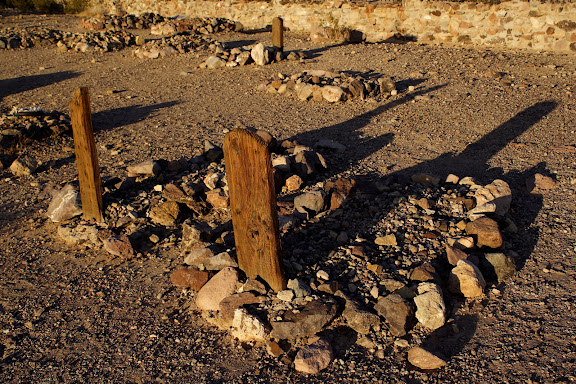
They waited in the car, the windows rolled down, peering up at the dusty signs and dark windows of the admissions booth. The cost was one dollar for adults, fifty cents for kids under 15, and free for those under five, but the sign was smudged with layers of dirt and no ticket collector was coming from the battered, wooden door. The door was heavy and fixed, had probably been stationary for decades, and a hole in the bottom corner of the window splintered outward in spider cracks.
“Get out and knock,” she said.
“There’s no one in there.”
He tapped on the horn.
The ghost town attraction was open from dawn to dusk and the dry sun was beating down one hundred and five degrees, but there was no one to be seen. There had been no cars, no buildings, no life or sign of life since they’d seen the billboard ten miles back on the highway. As touristy as it seemed, they didn’t expect it to actually be empty, to actually be populated solely by ghosts. They’d expected hokey reenactments and exaggerated museum attractions, slackjawed guides and fat wayfarers with overzealous camera triggers.
He shifted gears and proceeded down the dirt road, the baked gravel crunching beneath the tires.
“No,” she said. “Wait. We can’t.”
“Why not?”
“We didn’t pay. We’re trespassing.”
“There’s no one here,” he said. He kept driving. “Nobody at all.”
The road inclined and snaked to a three-pronged fork, where a signpost pointed one finger toward Town Hall, another to the mines, and a third to the cemetery. He turned left, a narrow path flanked by hills of sediment. Drought-blighted sagebrush sprouted thorny fingers to the white sky, their tiny yellow leaves not quite dead, begging the question of what worth was in living. The path rose and turned, and they passed through a massive wrought-iron gate, an inauthentic recreation, the town’s name sculpted atop in gothic curls. The town lay before them like an abandoned movie set, sandblasted by windblown debris. Everything was a shade of brown. The original buildings, over one hundred years old, were distinct in their stoic postures, stolid with dementia. The recreations, so obviously refabricated from newer materials and cheaper designs, were the decaying structures, weeded and gaping. A patina of tourism gilded everything with exuberant, sunbleached signs and Wild West themed kiddie rides from the world of imagination.
He pulled up to the general store and parked, climbed out and stretched his legs. She followed, leaving her door and her options open.
“You don’t think it’s unsafe?” he asked. “Maybe they had to shut it down?”
She scoped everything, walked to the store and approached the window. The glass was warped like melting, slightly less than transparent. She touched the cool panes and sniffed the black spots on her fingertips, then cupped her hands and peered through. Stillness resonated inside. Empty chairs and unmanned counters, mostly bare shelves with vintage cans and tins or with nothing at all on display. A life-size painting of a lady and a gentleman, their faces two cut-out ovals, stood against one wall. In a back corner was a Coke machine, at most only ten years, and she could imagine she heard it whirring still. She shivered.
A handwritten paper sign on the door read, “Sorry, we’re Open,” but it was locked. She turned around and folded her arms tight to her chest.
He was trying to maneuver a rusted wheelbarrow across the road.
She returned to the car and closed the door. A few seconds later, he joined her. The beeping of the seatbelt reminder, the hum of the engine, and the blast of the air conditioner were startling. She turned off the vents.
They drove back to the fork. “The mines?” he asked.
“No,” she said.
He drove to the cemetery, a small, pebble-strewn mound of a lot overlooked by the red mountains. They parked and walked through the murmuring gate. Human-length rock
He was higher, toward the back of the lot, and she walked to him. He stared down at six graves, six six-foot-long piles of stones with actual granite tombstones instead of wooden planks, their polished, flat faces engraved with real names and official dates. The deaths were scattered across the past fifteen years. Mary “Mary Lou” Ellerbee, “Postmaster General.” Joseph “Ole Buck” Hanson, “Six Shootin’ Sheriff.” Ronald Tyler, “Town Crier.” The most recent grave was less than two years old, and on it was engraved a sketching of the cemetery they were standing in, the mountains in the background, a cross atop one, and the sun setting behind, spewing forth crepuscular rays.
“They’re dead,” he said. “These are the people who ran the tourist stop. The ghost town died. It died back in the day and they rebuilt it, turned it into an amusement park. And then all those people died. There’s two eras of ghosts here.”
The new placards were the cleanest and brightest artifacts in the whole town, the most untinged by dust and commercialism, the most chilling and intimate.
“Should we say a prayer?” she asked.
He smiled.
Ronald Tyler, “Son of Amaranth” aged 91 at the time of his death four years past, had tiny words of verse beneath his dates:
And where the river of bliss through midst of heaven
Rolls o'er elysian flowers her amber stream:
With these that never fade the spirits elect
Bind their resplendent locks.
They drove south and east, further into night, the sun sinking behind them.
Subscribe to:
Posts (Atom)
